Why Some Google Reviews Don't Show Up in Search (and How to Surface Them)

Updated: Aug 7
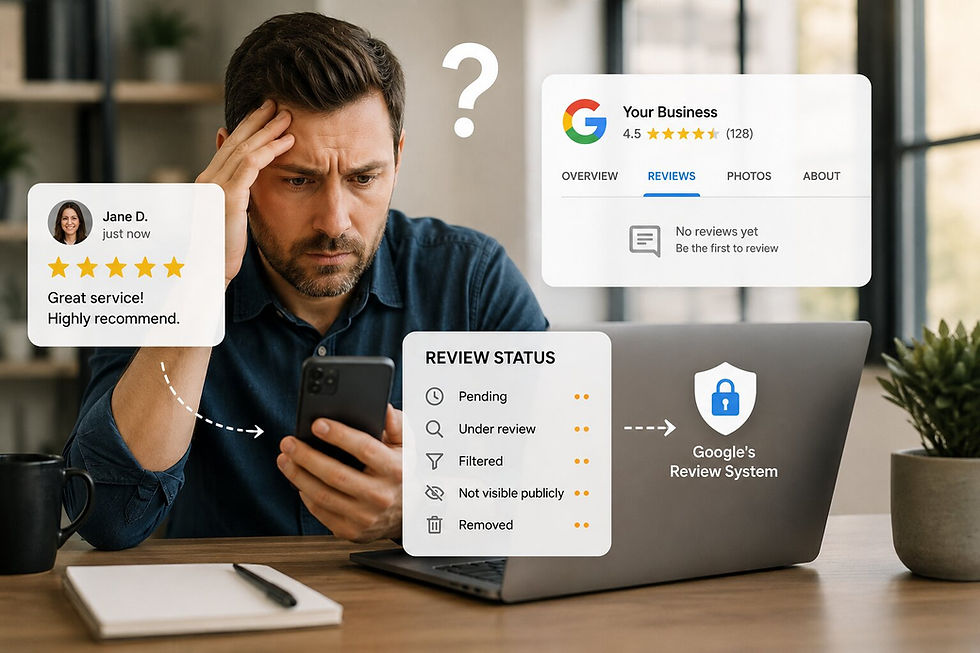
A customer tells you they left a Google review. You check your profile. Nothing.
A day passes. Still nothing.
It is one of the most common questions business owners ask: where did the review go?
Here is the reassuring part. A missing review does not automatically mean it was deleted. Google reviews can be delayed, held for screening, filtered, hidden from public view, or removed entirely. Each of those is a different situation with a different fix. Many business owners wonder why Google reviews don't show up even after a customer confirms they posted one.
In 2026 there is also a new wrinkle worth ruling out before you panic.
Why Google Reviews Don't Show Up: Rule Out the 2026 Display Bug First
Starting in October 2025, Google confirmed a Business Profile bug that caused reviews to stop displaying correctly, with review totals that did not match the reviews actually on the listing. Businesses were still reporting it well into early 2026. On top of that, a wave of moderation sweeps in early 2026 pulled large batches of reviews from profiles, including legitimate ones, often with no explanation.
So if your review count dropped suddenly, or a group of reviews vanished at once, check whether other businesses in your area or industry are reporting the same thing. The Google Business Profile Help forums and local SEO communities are the fastest way to tell a platform-wide issue apart from a problem with your own profile. If it is a known bug or sweep, the fix is usually patience, not panic.
Not Every Review Appears Immediately
Many reviews appear within minutes. Others take hours or even a few days.
Google screens reviews before showing them publicly, watching for spam, fake engagement, suspicious activity, and policy violations. If a review trips one of those checks, it can sit in a holding state before going live. This is why one customer sees their review instantly and another waits days.
As explained in How Long Does It Take for a Google Review to Show Up?, most delays are normal and temporary.
Google's Filters Catch Real Reviews Too
Google's filters exist to block fake reviews, and they are aggressive. The tradeoff is that genuine reviews sometimes get swept up with them.
A legitimate review is more likely to be filtered when:
The reviewer's account is brand new or barely used
The review contains a link or URL, which Google treats as spam and removes almost immediately
Several reviews land in a short window from the same place, device network, or QR code
The account shows unusual activity
The wording looks templated or spammy
That third point catches more businesses than they realize. If you push a stack of reviews through a single QR code at the counter in one afternoon, Google can read that burst as manipulation and filter the whole batch. Steady, spread-out review activity looks far more trustworthy than a sudden spike.
Reviews Can Disappear After They Go Live
This is the one that causes the most confusion.
The review appears. You see it. Days later it is gone.
Google keeps re-evaluating reviews after they publish. A review that cleared the first check can be pulled later when a secondary filter catches something the first one missed, or when Google updates its detection systems and re-scans older reviews. The owner rarely gets an explanation. Neither does the reviewer. From the outside it looks random. From Google's side it is ongoing quality control.
"But I Can See It": Why Your View and the Customer's Don't Match
Here is the detail that explains most of these situations.
A filtered or held review does not vanish for everyone. The customer can usually still see it in their own Google contributions, and it may even appear in your Business Profile dashboard. What it does not do is show up on your public listing or on Google Maps.
That gap is why a customer swears they posted a glowing review while you see nothing public. They are not wrong, and neither are you. The review exists. It is just not being shown publicly.
So before assuming a review was deleted, ask the customer to open their own Google account and check whether it still appears there. That single question tells you whether you are dealing with a filter or a genuine removal.
Reviews That Break Policy Get Removed
Google removes reviews that violate its content policies. Common triggers include:
Fake or paid reviews
Reviews left in exchange for a discount, gift, or any incentive
Offensive, irrelevant, or off-topic content
Duplicate submissions
Reviews from accounts Google has flagged
In 2026 this list got longer, and it caught a lot of businesses off guard. In April 2026 Google tightened its review rules and began enforcing them automatically with AI-driven systems. Practices that were common for years are now explicit violations:
Asking customers to mention a staff member by name, or to include a specific service, keyword, or star rating
Setting staff review quotas, or paying bonuses tied to review counts
Pressuring customers to leave a review while they are still on your premises, including reception kiosks and shared tablets
Review gating, meaning only inviting the customers you expect to be happy
If your collection process still leans on any of these, reviews generated that way can be removed, and repeat violations can put the whole profile at risk. Asking for reviews is still completely allowed. What you can no longer do is direct what goes in them or screen who gets asked. A neutral request sent to every customer is the safe version.
Can Missing Reviews Come Back?
Sometimes.
If the review was only delayed, it shows up on its own.
If it was filtered by mistake, it can reappear when Google re-evaluates.
If it was removed for a policy reason, recovery is unlikely.
There is no button that forces a review back into public view. That is frustrating, but it is how the system works, and it is the reason the smartest move is rarely to fight over a single review.
The Real Problem Is Almost Never One Review
Here is what most businesses miss.
If one missing review noticeably dents your profile, the missing review is not really the problem. Your review volume is.
A business with 15 reviews feels every loss. A business with 500 barely notices. Review count and recency are among the strongest local ranking signals, so a thin, stop-start review history leaves you exposed every time Google runs a filter, ships a bug, or sweeps a batch.
The businesses that stay steady are not the ones that never lose a review. They are the ones generating enough genuine, recent feedback that no single loss matters. That is the thinking behind Why Happy Customers Don't Leave Google Reviews: most businesses have far more satisfied customers than reviews, and the gap is the opportunity.
What to Do When a Review Goes Missing
Check whether it is a known bug or sweep before anything else
Wait 48 to 72 hours, since many reviews are only delayed
Ask the customer to confirm the review still shows in their own Google account
Re-read Google's review content guidelines for anything that might have tripped a filter
Do not ask the customer to delete and repost, since a second identical attempt often looks like spam and gets filtered too
Keep collecting new reviews, the right way, on a steady schedule
The last point is the one that actually moves the needle. Google's review system will never be fully predictable. The businesses that win treat review collection as an ongoing process, not a one-time push.
The Bottom Line
A missing Google review does not always mean something went wrong. It might be delayed, held for screening, filtered, hidden from public view, or removed. In 2026 it might also be a known display bug or a moderation sweep that has nothing to do with you.
Whatever the cause, the lesson is the same. Do not let one missing review become the center of your reputation strategy. Strong businesses do not depend on any single review. They build a steady, policy-compliant process that keeps genuine feedback coming.
That is exactly what QuickFeedback is built for. Customers scan a QR code and share private feedback first, then reach the same option to post a public Google review in their own words. Every customer sees that option at the same prominence regardless of sentiment, with no gating and no scripted content, which keeps you on the right side of Google's 2026 rules while building the review volume that protects you.
No credit card required, and turn customer feedback into a consistent system instead of a guessing game.